
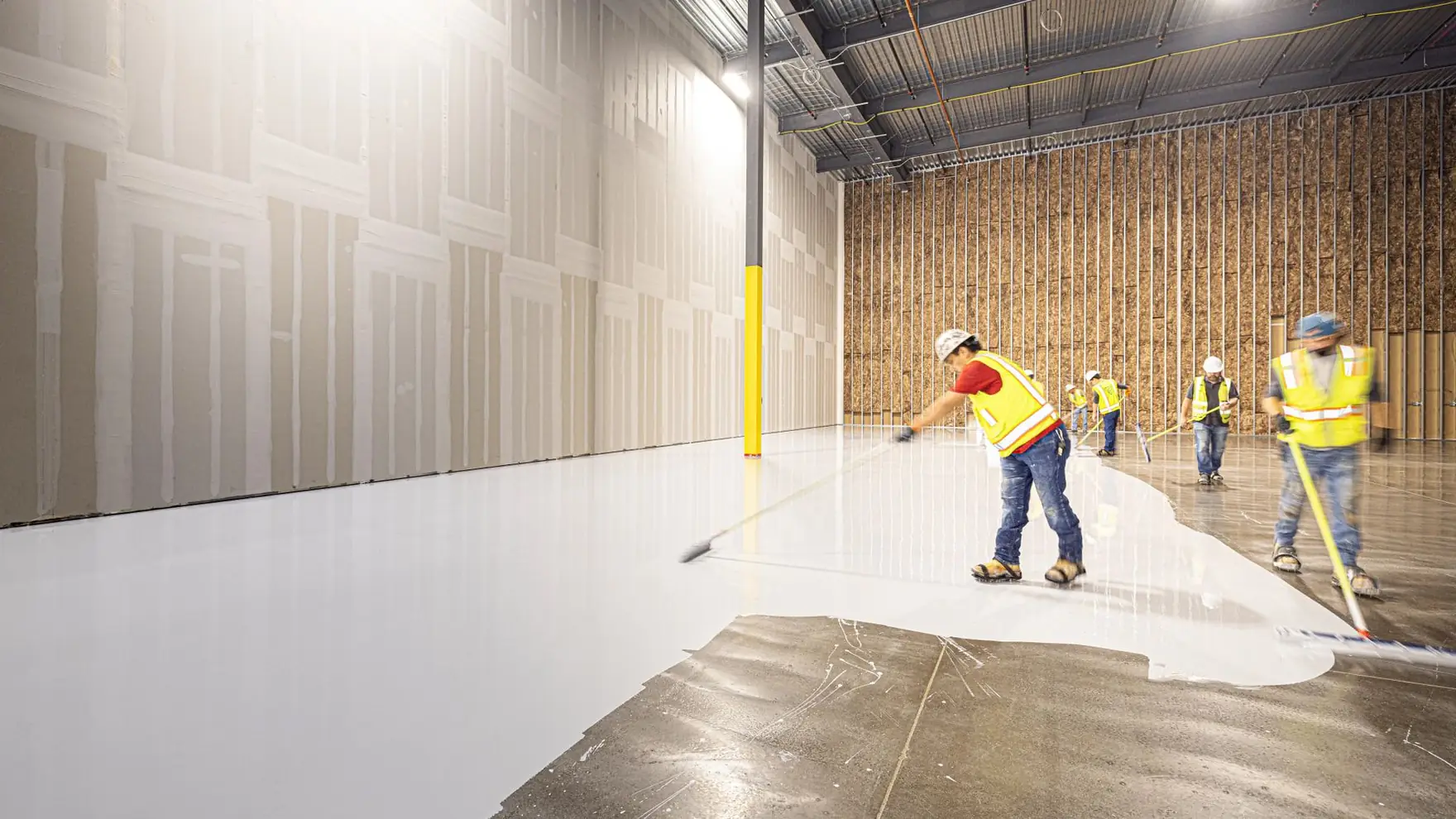
Hand-poured. Every floor is one of one.
Metallic Epoxy Floors in Dallas and Fort Worth
Short answer
A metallic epoxy floor is a pigmented epoxy base with reflective metallic pigment suspended in a clear resin poured over it and moved by hand until the pattern is right. Single color metallic runs from $12 installed in Dallas-Fort Worth. Vehicles are back on the floor at about 24 hours.
A floor that looks like poured stone, liquid metal or moving water, and belongs to nobody else.
Overview
A metallic epoxy floor is a pigmented epoxy base with reflective metallic pigment suspended in a clear resin poured over it and moved by hand until the pattern is right. In Dallas-Fort Worth it starts at $12 per square foot installed and goes up with color count and floor complexity.
This is the high end of what we install. It is not a value coating and we do not sell it as one. What it does is produce a floor with visual depth that no flake system, stain or polish can match, one that changes as you walk across it because the pigment reflects light at different angles.
Professional Garage Concepts has worked DFW floors since 2001 and carries 532 Google reviews at 4.8 stars. Metallic in particular has to be seen in person, so we keep real pour samples at our Keller and Grand Prairie showrooms. Call (817) 381-6173.
How a metallic pour actually works
Metallic epoxy is not a paint color. The metallic component is a fine reflective pigment, and the effect comes from what that pigment does while the resin is still liquid.
A pigmented epoxy base coat goes down first and cures. That base sets the deep color of the floor and blocks the concrete from reading through. Then a clear 100 percent solids epoxy is mixed with the metallic pigment and poured onto the base.
What happens next is where the floor is made. The installer moves that liquid with squeegees, rollers, brushes and air. Pushing the resin creates flow lines. Blowing air across the wet surface with a torch or blower opens cells and craters that read as depth and movement. Spritzing solvent or alcohol makes the pigment separate and cluster. The pigment settles at different rates through the film, and that vertical separation is what produces the three-dimensional look.
Then a clear topcoat locks it. The whole effect is generated in about a 40-minute window while the resin is still workable. It is the most skill-dependent floor we install and it is why crew experience matters more here than product brand.
Single color vs multi-color
You can absolutely do a metallic floor in one color. It is a common question and the answer surprises people, because a single-color metallic still has enormous depth. The pigment separation and the cell work create light and dark variation across the floor without any second color at all. A single pearl white, a single graphite, or a single copper reads like polished stone.
Single color is also the more architectural choice. It suits a retail floor, a modern kitchen or a large open commercial space where a dramatic two-tone pour would fight the rest of the room.
Multi-color is where the movement comes from. Two colors give you veining and contrast, closest to marble or a weathered metal. Three or more starts reading as a designed feature rather than a floor finish and works best in a space that can carry it, like a car showroom or a feature garage.
The more colors, the more the outcome depends on the installer's hands and the less it can be predicted from a sample. We talk that through before we quote.
- Single color. Depth from pigment separation and cell work alone. Architectural, calmer, and the easiest to plan a room around.
- Two color. Veining and contrast. The most requested residential metallic. Reads like stone or oxidized metal.
- Three or more. Dramatic and unpredictable. Best in showrooms, retail and feature spaces with sight lines that support it.
- Base color matters as much as the metallic. A black base under pearl pigment is a completely different floor than a white base under the same pigment.
Every metallic floor is unique, and that cuts both ways
We want to be direct about this before anybody signs. A metallic floor cannot be exactly reproduced. Not from a photo, not from a sample panel, not from another job we did last month. The pattern is created live on your slab by the movement of liquid resin, and no two pours land the same way.
What we can control and commit to is the color palette, the general character, and the density of the pattern. Whether it is subtle or dramatic, tight or open, veined or cloudy. What we cannot promise is that a specific swirl in a photo will appear in your garage.
The practical consequence: if you need an exact, repeatable, predictable finish, metallic is the wrong product and a flake system or polished concrete is the right one. If you want a floor nobody else has, that is exactly what this is.
The same applies to repairs. A damaged section of a metallic floor cannot be spot repaired invisibly. A patch will not match the surrounding pour. Significant damage means recoating the whole area or the whole floor. That is worth knowing going in, and it is one reason we install metallic in spaces that are looked at more than they are worked in.
Gloss vs satin topcoat
The topcoat is the second-biggest decision after color, and it changes the floor more than most people expect.
High gloss gives maximum depth. The reflection is what makes a metallic floor read like water or polished stone, and gloss is what delivers that. It is the standard choice for showrooms and retail because the floor reflects lighting and product and makes the space feel larger. The cost is that gloss shows everything: dust, footprints, water spots and every scuff. In a working garage it needs regular attention.
Satin cuts the reflection back. You lose some depth, but the floor becomes far more forgiving day to day. Dust does not show, tire marks do not show, and it does not read as a maintenance obligation. For a residential garage that gets used, we recommend satin more often than customers expect.
On the chemistry: a clear polyaspartic topcoat over a metallic epoxy pour is the build we prefer. It gives UV stability that a clear epoxy topcoat does not have, which matters on any floor that sees sunlight through a window or an open garage door. Clear epoxy over a metallic pour ambers, and yellowing over a cool gray or pearl metallic ruins the color.
Where metallic belongs, and where it does not
Metallic epoxy is a finish decision, not a durability decision. The system underneath is a standard high-build epoxy floor and it is durable. What you are paying the premium for is appearance. So the question is always whether the space is one where appearance is worth $12 or more per square foot.
Where it works: car showrooms and dealership floors, retail spaces, salons, restaurants and bars, medical and dental offices, commercial lobbies, home bars and game rooms, wine rooms, and collector garages where the floor is part of the display. Anywhere the floor is meant to be seen.
Where we steer people away from it: a working shop where welding sparks and dropped steel will scar it, a garage where the floor spends its life under two vehicles and storage bins, a slab with high moisture vapor emission that needs a barrier primer eating into the budget, and anywhere the buyer needs an exactly predictable result. In a standard family garage, a full flake system at $6 to $8 per square foot delivers a better outcome for the money and hides wear far better.
We say this on quotes regularly. If your garage is going to be a garage, buy flake. If your garage is going to be a room, metallic earns its price.
Metallic on a DFW slab
Metallic has one specific weakness that matters more here than in most markets: it is a smooth, high-gloss film with nothing broadcast into it, so it shows slab issues rather than hiding them.
A flake floor can absorb minor slab irregularity because the chip layer breaks up the sight line. Metallic does the opposite. Because the surface is reflective and continuous, a low spot, a high spot along an old patch, or a crack repair that was not ground perfectly flush will catch the eye across the whole floor. That means slab preparation on a metallic job is more demanding, not less, and it is part of why the price is higher.
Moisture matters more too. A high-gloss non-breathable film over a slab with vapor drive shows blistering plainly. We test moisture with a calcium chloride kit or an in-slab RH probe on every metallic job, without exception, and price a 100 percent solids epoxy vapor barrier primer when the numbers require it.
Active cracking from Blackland Prairie clay movement is the other honest limit. A metallic pour will not bridge a slab crack that keeps moving, and when the crack telegraphs through it is highly visible on a reflective floor. On slabs like that we recommend addressing the movement first or choosing a different finish.
How it works
How we install a metallic epoxy floor
- STEP 01
1. Slab evaluation and mandatory moisture testing
Every metallic job gets moisture tested, either with a calcium chloride kit or an in-slab relative humidity probe. A reflective, non-breathable film shows osmotic blistering plainly, so there is no guessing. We also map flatness, since a metallic floor reveals high and low spots that a flake floor would hide.
- STEP 02
2. Diamond grind to a clean, flat profile
The slab is ground with diamond tooling on a dust-shrouded planetary grinder to a CSP 2 to 3 profile, and we spend extra time flattening rather than just profiling. Edges and corners are hand-ground to match. No acid etching. On metallic the flatness work is as important as the bond work.
- STEP 03
3. Crack, spall and joint repair, ground dead flush
Cracks are chased, blown clean and filled. Spalls and pop-outs are patched with fast-set repair mortar. Everything gets ground dead flush, because on a reflective floor a repair sitting a few thousandths proud catches light across the whole room. On post-tension slabs we scan before any cutting.
- STEP 04
4. Vacuum, mask and control the environment
The floor is HEPA vacuumed twice and fully masked. Then we close the space down. Airborne dust that lands in a wet metallic pour stays there permanently, and a cross breeze through an open door changes the cell pattern in ways nobody wants. Temperature and airflow get controlled for the whole pour.
- STEP 05
5. Primer or vapor barrier, then pigmented epoxy base coat
A vapor barrier primer goes down first if the moisture test called for it. Then the pigmented 100 percent solids epoxy base coat is applied and cured. This base sets the underlying color and stops the concrete from reading through the metallic layer, so it is chosen deliberately against the pigment, not defaulted to gray.
- STEP 06
6. Mix and pour the metallic layer
Clear 100 percent solids epoxy is mixed with metallic pigment in measured batches and poured onto the cured base. Mix ratio and induction time are held exactly, because an off-ratio batch of epoxy never fully cures. On multi-color floors the colors are poured in sequence with the working window planned before anybody opens a pail.
- STEP 07
7. Work the pattern by hand
The installer moves the wet resin with squeegees, rollers and brushes to set the flow lines, then uses air and solvent to open cells and separate the pigment into the depth you see in the finished floor. This is the entire look of the floor and it happens in roughly a 40-minute window. It is not something a crew learns on your slab.
- STEP 08
8. Cure, then clear polyaspartic topcoat
The metallic layer cures fully before anything goes over it. Then a clear polyaspartic topcoat goes down in gloss or satin. Polyaspartic gives UV stability that a clear epoxy topcoat cannot, which matters wherever sunlight reaches the floor. High-traffic commercial floors get two topcoats.
- STEP 09
9. Cure and return to service
Foot traffic is fine a few hours after the polyaspartic topcoat and vehicles come back at about 24 hours. We walk the floor with you in the lighting it will live under, since metallic looks different under daylight, LED and incandescent. Care instructions are simple: neutral pH cleaner only, nothing acidic.
Straight pricing
Metallic epoxy floor cost in Dallas-Fort Worth
Metallic is quoted per floor rather than off a rate card, because color count, slab flatness, moisture condition and the complexity of the pattern all move the number. These bands are what typical DFW jobs land in, and every quote is written and itemized before work starts.
Single color metallic
from $12per sq ft installed
Architectural spaces, retail floors and residential rooms wanting depth without a dramatic multi-tone pattern.
- Full diamond grind and flatness work
- Crack and spall repair ground flush
- Moisture testing
- Pigmented epoxy base coat
- Single-color metallic pour, hand worked
- Clear polyaspartic topcoat, gloss or satin
Multi-color metallic
$13 to $16per sq ft installed
Feature garages, showrooms, bars and lobbies where the floor is meant to be the thing people notice.
- Everything in the single color system
- Two or more metallic colors poured in sequence
- Veining, cell work and pattern development by hand
- Sample pour reviewed with you before the floor pour
- Gloss or satin polyaspartic topcoat
Commercial metallic, 1,000 sq ft and up
$12 to $14per sq ft installed
Showrooms, retail buildouts and large open commercial floors where square footage brings the rate down.
- Volume rate on larger continuous pours
- After-hours and phased scheduling available
- Two clear polyaspartic topcoats for traffic
- Moisture barrier primer priced separately if testing requires it
Moisture vapor barrier primer
$1 to $2per sq ft add-on
Any slab that tests high for moisture vapor emission. Required on metallic more often than on other systems.
- Calcium chloride or in-slab RH testing
- 100 percent solids epoxy vapor barrier primer
- Additional cure day in the schedule
Answers
Frequently asked questions
Still stuck? Call (817) 381-6173 and talk to someone who does this every day.
How much does a metallic epoxy floor cost in Dallas?
Metallic epoxy floors in Dallas start at $12 per square foot installed for a single color and run $13 to $16 for multi-color work. Larger commercial pours over 1,000 square feet typically price at $12 to $14. A moisture vapor barrier primer, when testing calls for one, adds $1 to $2 per square foot.
Can I do just one color of metallic epoxy?
Yes, and single-color metallic floors have far more depth than people expect. The metallic pigment separates through the resin and the installer opens cells with air, so light and dark variation develops across the floor without a second color. Single color reads more architectural and suits retail and open commercial spaces well.
Are metallic epoxy floors slippery?
A high-gloss metallic floor is slick when wet, because the surface is a smooth continuous film with nothing broadcast into it. For spaces that get wet we add polymer or aluminum oxide grit to the clear topcoat, which changes the feel slightly but keeps the visual depth. A satin topcoat also helps a little.
Can a metallic epoxy floor be repaired if it gets damaged?
Not invisibly. The pattern is created live during the pour and cannot be matched in a patch, so a damaged area is repaired by recoating a full section or the whole floor. This is worth knowing before you buy, and it is one reason we recommend metallic for display spaces more than for working shops.
Will two metallic floors ever look the same?
No, two metallic floors are never identical, because the pattern is created by moving liquid resin by hand and no two pours land the same way. We can commit to the color palette, the density of the pattern and the general character, subtle or dramatic. We cannot promise a specific swirl from a photograph will appear on your slab.
Should I choose gloss or satin on a metallic floor?
Choose gloss when depth and reflection matter most, which is usually showrooms, retail and display spaces. Choose satin for a floor that gets used, because it hides dust, footprints and tire marks far better while giving up some of the depth. In residential garages we recommend satin more often than customers expect.
Does metallic epoxy fade or yellow in sunlight?
Epoxy is aromatic and ambers under UV, so a metallic pour finished with a clear epoxy topcoat will yellow anywhere sunlight reaches it. We finish metallic floors with a clear polyaspartic topcoat instead, which is aliphatic and holds its color. On a cool gray or pearl metallic, that difference is very visible over a few years.
Is metallic epoxy a good choice for a regular family garage?
Usually not. In a garage that holds two vehicles, storage and a workbench, a full flake system at $6 to $8 per square foot hides wear better and costs roughly half as much. Metallic makes sense when the space is a display or a room people spend time in, such as a collector garage, home bar or showroom.
Related services
Garage Floor Coatings
We grind the slab down to clean concrete, fix what is broken, and put down a coating system matched to your floor and how you use it. Two DFW showrooms where you can hold the real samples.
Learn moreFlake Floor System
Vinyl flake broadcast to refusal into a polyurea base, scraped flat, and locked under a clear polyaspartic topcoat. Most two-car garages done in a single day.
Learn moreEpoxy Floor Coatings
We grind every slab to bare, profiled concrete, test for moisture vapor, and prime accordingly. Then we tell you honestly whether epoxy or polyaspartic is the better spend on your floor.
Learn morePolished Concrete
We grind your existing slab through a diamond grit sequence until the concrete itself is the finished surface. Densified, joint filled, stain guarded, and priced by the square foot before you commit.
Learn moreComplete Garage Transformation
We do the floor, the storage, the lighting, the door, the opener and the driveway gate on one schedule with one company standing behind the finished garage. 532 Google reviews at 4.8 stars.
Learn moreReady to get metallic epoxy handled?
Call (817) 381-6173 or send the form. We answer quote requests the same business day, and we have been doing this across DFW since 2001.