
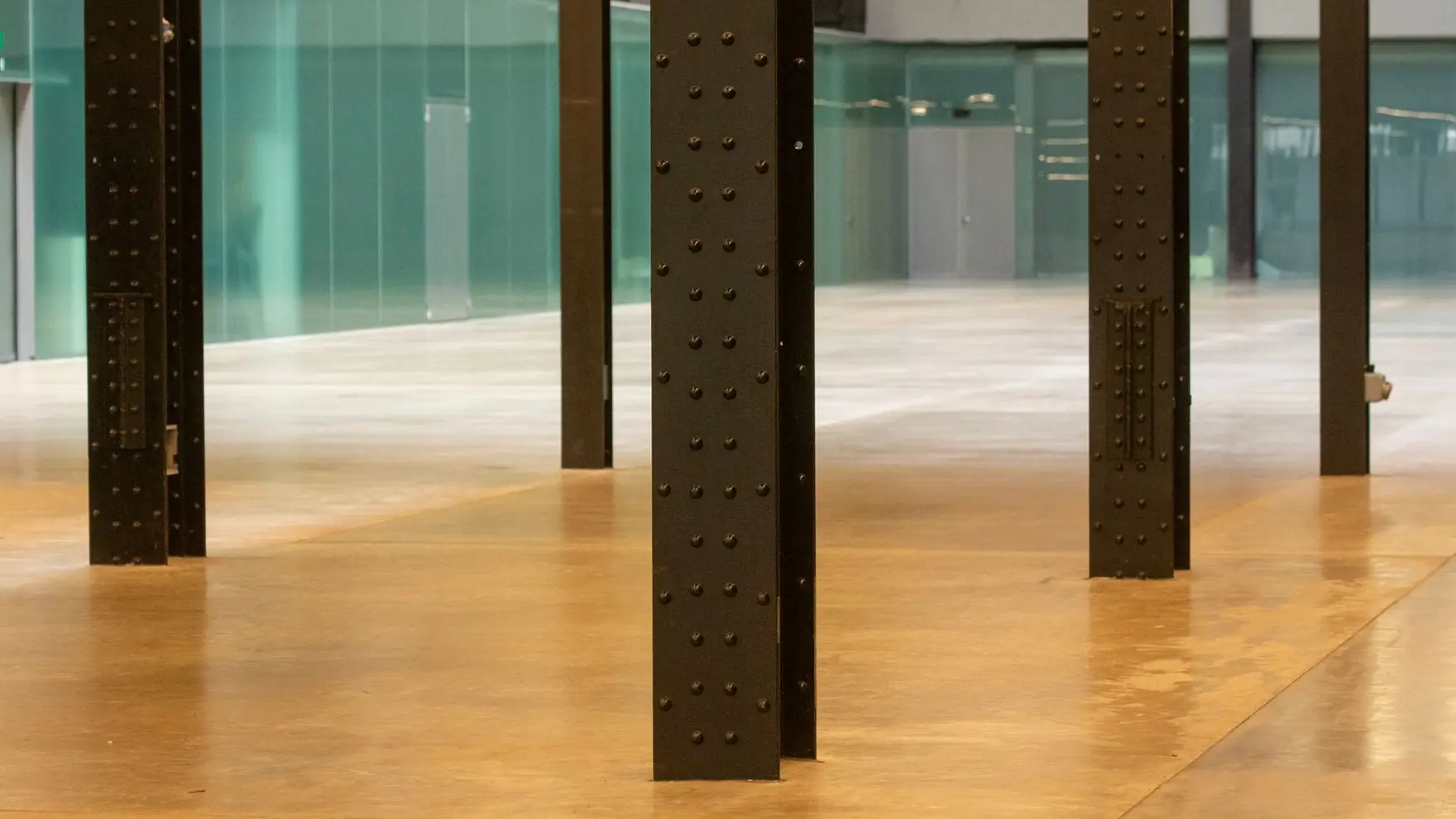
Mechanically Polished Concrete
Polished Concrete in Dallas and Fort Worth
Short answer
Polished concrete is your existing slab ground and refined with progressively finer industrial diamonds until the concrete itself becomes the finished floor, with no coating on top to peel or delaminate. Cream polish runs $3.50 to $6.00 per square foot in Dallas-Fort Worth, salt and pepper $3.50 to $9.00, and rock cut $9.50 to $12.00. Price drops sharply as square footage rises. Same-day service is available.
A floor that cannot peel, because nothing was laid on top of it
Overview
Polished concrete is your existing slab ground and refined with progressively finer industrial diamonds until the concrete itself becomes the finished floor. There is no coating, no topping and no film. That is the whole point, and it is the reason a properly polished floor cannot peel, blister, delaminate or fail from hot tire pickup, because there is nothing on top of the concrete to lift off.
Professional Garage Concepts polishes concrete across Dallas, Fort Worth and the surrounding metroplex. We have worked on DFW floors since 2001, hold 532 Google reviews at a 4.8 star average, carry an A+ BBB rating, and are licensed, bonded and insured. Commercial clients include Herzog and Coca-Cola. You can see finished polished panels in person at our Keller or Grand Prairie showrooms, which matters here more than in any other finish we sell, because gloss and aggregate exposure do not photograph honestly.
This page covers what mechanical polishing actually is, the grit sequence, gloss levels, the three aggregate exposure classes and what determines which one you can get, densifiers, joint fill, stain guarding, and real per square foot pricing including add-ons. If you read one section, read the one on aggregate exposure. It is where most polished concrete disappointment in DFW comes from.
What mechanical polishing actually is, and what it is not
Mechanical polishing is an abrasive process. Planetary grinders fitted with diamond segments cut into the surface of the slab, and each successive pass uses a finer diamond that removes the scratch pattern left by the pass before it. Once the surface is refined far enough, the concrete reflects light on its own. The gloss is a property of the concrete, not of something applied to it.
That is very different from the two things often sold under the same name. A topical polish, sometimes called a polished overlay, a guard coat or a burnished floor, is a wax, acrylic or urethane film buffed to a shine. It looks similar on day one. It wears through in traffic lanes, it needs stripping and reapplying, and it can peel. A coating, meaning epoxy, polyaspartic or urethane, is a plastic film bonded to the slab. Coatings have real advantages, chemical resistance and unlimited color chief among them, but they are a film with a bond line, and every film has a way to fail.
The test is simple. If a contractor quotes polished concrete and the scope lists a product that gets rolled or sprayed on to create the shine, it is not mechanically polished concrete. Ask what grit sequence they run and what densifier they use. If there is no answer, that is your answer.
- Mechanically polished: gloss comes from refining the concrete itself. No film. Cannot peel.
- Topical polish or guard coat: gloss comes from an applied wax or acrylic. Wears through traffic lanes. Requires stripping and recoating.
- Coating: epoxy, polyaspartic or urethane film bonded to the slab. Colorable and chemical resistant, but it is a film with a bond line.
- Grind and seal: a real middle option. The slab is ground flat, then sealed rather than polished. Cheaper, faster, and it is a film.
The grit sequence, step by step
Polishing runs in two stages using two different kinds of diamond tooling. Metal bond diamonds do the cutting. Resin bond diamonds do the refining. Skipping steps in either stage is the most common corner cut in this trade, and it shows up months later as a floor that looks hazy or scratches easily.
A typical full polish runs something like this. Metal bond 30 or 40 grit opens the floor and establishes the aggregate exposure. Metal bond 80 removes those scratches. Metal bond 150 refines further. Then the densifier goes down and is allowed to react. Then resin bond 100 or 200, 400, 800, 1500 and, on the highest gloss floors, 3000. Each pass has to fully remove the scratch pattern from the previous one before the next pass begins, which is why the last three passes take longer than people expect and produce almost no visible dust.
The number of passes is not fixed. A soft slab takes more; a hard, well-cured slab takes fewer. What is fixed is the discipline: no skipped grits, and the floor is checked under raking light between stages.
Gloss levels: what 400, 800, 1500 and 3000 grit actually look like
Gloss level is a description of how far up the resin grit sequence the floor was taken. It is reported on a four-level scale, and each level corresponds roughly to a finishing grit. Higher is not automatically better. It is a choice about reflectivity, maintenance and how much the floor will show a scuff.
What changes between levels is reflected image clarity. At a low gloss the floor reflects light diffusely. At a high gloss you see distinct reflections of lights and objects, the way a polished stone floor behaves. In a Dallas retail space, a high gloss floor bounces enough light that lighting designers often reduce fixture count. In a busy Fort Worth warehouse aisle, a mid gloss is usually the smarter specification, because it holds its appearance between maintenance cycles better than a mirror does.
- Level 1, flat or ground. Finished around 100 to 200 grit. Very little reflection. Common in back-of-house, mechanical rooms and warehouse space where dust control matters more than looks.
- Level 2, satin. Finished around 400 grit. A low sheen with no distinct reflected image. Reads as a clean, matte industrial floor. Popular in modern residential and restaurant work.
- Level 3, semi-polished. Finished around 800 grit. Clear reflection at a distance, softer up close. The most commonly specified level for retail and office floors and the best all-around balance of appearance and maintenance.
- Level 4, highly polished. Finished at 1500 to 3000 grit. Sharp reflected images, wet-looking gloss. Highest impact and the level that shows scuffs and maintenance lapses most readily.
- Moving from a lower gloss to a higher one adds roughly $0.40 to $0.75 per square foot to the job.
Aggregate exposure: cream, salt and pepper, and rock cut
How deep we cut on the first pass determines what you see in the finished floor, and this is the single most important decision in polished concrete. Concrete is cement paste with sand and stone in it. When it was placed, the finisher floated the paste to the top, so the very surface is nearly pure paste. Cut a little and you keep that paste. Cut deeper and you open the sand. Cut deeper still and you slice the stone in half.
Here is the part most contractors do not put in writing. You do not entirely get to choose. What exposure is achievable depends on the slab you already own: how thick the cream layer is, how flat the slab was finished, how uniformly the aggregate settled, and how much material we can safely remove. On a slab with high spots and low spots, cutting deep enough to expose aggregate in the low areas means cutting far deeper in the high areas, and the exposure will vary across the room. On a post-tension residential slab, common throughout DFW, there is a limit to how much material comes off before we are cutting into cover we should not touch.
We grind a test area first and show you what your specific slab gives at each depth. That test costs almost nothing and it is the difference between a floor you love and a floor you tolerate.
- Cream polish, sometimes called Class A or no exposure. The paste layer stays. You get a soft, cloudy, uniform look with almost no stone showing. The least expensive polish because the least material is removed. $3.50 to $6.00 per square foot.
- Salt and pepper, Class B or fine aggregate exposure. Cut roughly one sixteenth of an inch down to reveal the sand. A speckled, even, consistent look and the most requested finish in DFW. From $3.50 per square foot on large floors, near $9.00 on small ones.
- Rock cut, Class C or D, full aggregate exposure. Cut a quarter inch or more to slice through the large stone. Reads like terrazzo. Dramatic, expensive, and the exposure most dependent on what the slab actually contains. $9.50 to $12.00 per square foot.
- Honest caveat: aggregate distribution in a slab is never perfectly uniform. Rock cut floors show variation. That variation is the character of the finish, and if you want perfect uniformity you want a coating, not a polish.
Densifiers, and why they are not optional
A densifier is a liquid silicate, usually lithium, that soaks into the open concrete after the cutting passes. It reacts with the free calcium hydroxide in the cement paste and forms additional calcium silicate hydrate, which is the same compound that gives concrete its strength. The result is a harder, tighter surface with fewer open pores.
Three things follow. The floor stops dusting, which is the main reason warehouses densify at all. The surface holds a polish better and to a higher gloss, because there is more solid material for the fine grits to refine. And the concrete becomes more resistant to liquid getting in, though densifier alone is not a stain blocker and any contractor telling you otherwise is overselling it.
Timing matters. The densifier goes down after the metal bond passes and before the resin passes, so it penetrates open concrete rather than a closed surface. A densifier applied at the end of the job, on top of a finished polish, mostly sits there. Every polished floor we install includes a lithium densifier at the correct point in the sequence.
Joint fill and crack repair on DFW slabs
Control joints are saw cuts that tell the slab where to crack. They are doing their job when a crack appears in them. In a polished floor, an unfilled joint is a trap for dirt, an edge that spalls under wheel traffic, and the first thing your eye goes to in a room.
We clean joints out to a clean edge and fill them with a semi-rigid polyurea in areas that see forklift, cart or vehicle traffic. Semi-rigid fill supports the joint edge under a hard wheel, which is what stops the spalling that ruins warehouse floors. Where the slab genuinely moves, at isolation joints and at construction joints on expansive Blackland Prairie clay, we use a flexible sealant instead, because a rigid fill in a moving joint tears itself out.
Random cracks are chased out, filled and, where possible, seeded with matching aggregate or sand so they read as part of the floor. Be realistic about the result. A repaired crack in a polished floor is a repaired crack. It will be visible if you look for it. On a floor sitting on North Texas clay it may also open again seasonally. We will tell you which cracks are cosmetic and which are structural before we quote, and we do not paper over the difference.
- Joint fill from $2.50 per linear foot
- Cutting, cleaning and refilling previously filled joints from $4.25 per linear foot
- Minor crack and surface repair $1.00 to $2.00 per square foot
- Major repair, patching or leveling $2.00 to $3.00 per square foot
Stain guarding and what polished concrete will and will not resist
Polished concrete is dense, but it is still concrete, and concrete is porous. Densifier tightens the surface. It does not make it impervious. The last step on every floor we polish is a penetrating stain guard, an impregnating treatment that sits inside the top of the concrete and gives you time to wipe up a spill before it soaks in.
What it handles well: water, most food spills, coffee, oil drips on a garage floor if you catch them. What it does not handle: acids. Vinegar, citrus, wine, tomato, and acidic cleaners will etch polished concrete, which is a physical reaction with the cement and not a stain sitting on the surface. Etching cannot be cleaned off. It has to be repolished. This is the honest limitation of the product, and it is why we tell every homeowner the same thing: pH neutral cleaner only, forever.
Stain guard is a consumable. In a Dallas home it typically holds for several years. In a restaurant or a retail entry, plan on reapplying more often. Reapplication is a clean and wipe process, not a refinishing job, and it is inexpensive compared with anything you would do to maintain a coated floor.
Polished concrete in Dallas and Fort Worth buildings
Polished concrete has the lowest lifetime cost of any hard floor we install, which is why national retail and warehouse operators specify it by default. It is also increasingly common in DFW homes, particularly in modern builds, converted spaces and any room where the slab is already there and the owner would rather see the concrete than cover it.
A few DFW-specific notes. Polished concrete holds up well in this climate because it does not care about heat. A slab in an uncooled Grand Prairie warehouse hitting 100 plus degrees does not stress a polish the way it stresses a coating. Thermal mass also works in your favor in summer, since the floor stays cooler than the air. On the other side, polished concrete is hard and it is loud, so in a residential open plan expect to want rugs and soft furnishings for acoustics.
- Commercial: offices, medical suites, breweries, churches, gyms and tenant finish-out, usually at gloss level 3
- Residential: living areas, kitchens, sunrooms and garages, usually cream or salt and pepper at level 2 or 3
- Manufacturing: plant floors that need dust control and a hard, non-peeling surface under equipment
- Warehousing and distribution: densify and polish at level 1 or 2, with semi-rigid joint fill under lift traffic
- Retail: level 3 or 4 for reflectance, often with dye worked into the polish for brand color
Maintaining a polished floor
Maintenance is genuinely simple and genuinely non-negotiable. Dust mop daily or as often as the traffic warrants, because grit on the floor is sandpaper under every shoe and wheel. Damp mop or auto-scrub with a pH neutral cleaner. Never use anything acidic, and never use a cleaner that leaves a film, because film-building cleaners are how a mechanically polished floor ends up looking like a waxed one.
On a commercial floor, an auto-scrubber with the right pad handles the whole routine. On a residential floor, a microfiber mop and a neutral cleaner is the entire program.
Every few years, depending on traffic, the floor gets a burnish and the stain guard gets reapplied. A commercial floor in a heavy DFW retail entry might want that annually. A Dallas home typically goes far longer. A properly polished floor that is cleaned correctly does not need to be replaced, and that is the argument for it over every alternative.
How it works
How we polish a concrete floor
- STEP 01
Slab assessment and test grind
We walk the floor, check flatness and hardness, look at joints and cracks, and grind a test area to see what your slab actually gives at each cut depth. You look at the test patch before we agree on an exposure class. This step is what keeps expectations and reality in the same room.
- STEP 02
Demolition and containment
Carpet, tile, vinyl, adhesive, paint and any failed coating comes off first. Removal runs $1.00 to $3.00 per square foot depending on what is bonded down and how well. We wall off the area with plastic and run HEPA dust collection on every machine so adjacent space stays usable.
- STEP 03
Metal bond cutting passes
Planetary grinders with metal bond diamonds, typically 30 or 40 grit, open the slab and establish aggregate exposure, then 80 and 150 grit passes remove the previous scratch pattern. This stage sets the look of the floor. Everything after it is refinement.
- STEP 04
Crack, spall and joint work
With the slab open, cracks are chased and filled, spalls are patched, and control joints are cut clean and filled. Traffic joints get semi-rigid polyurea for edge support. Moving joints get a flexible sealant, because North Texas clay will move them seasonally no matter what we put in them.
- STEP 05
Densifier application
Lithium silicate densifier is applied to the open concrete and allowed to react. It forms additional calcium silicate hydrate inside the surface, which hardens the slab, stops dusting and lets the resin passes bring up a higher gloss. Timing is the whole trick here, and it happens before the resin passes, not after.
- STEP 06
Dye, if the floor is being colored
Water-based dye goes down after densifying and is worked into the open surface, then locked in by the remaining polish passes. Dye adds $1.00 to $2.00 per square foot. Because it sits inside the concrete rather than on it, a dyed polish wears the way the concrete wears.
- STEP 07
Resin bond polishing passes
Resin diamonds at 100 or 200, 400, 800, and where the gloss level calls for it 1500 and 3000, each fully removing the scratch pattern from the pass before. We check under raking light between grits. The last passes are slow, quiet and almost dustless, and they are what separates a real polish from a ground floor.
- STEP 08
Stain guard and walk-through
A penetrating stain guard goes on the finished surface, and the floor is burnished. We walk it with you under the building's own lighting, correct anything that needs it, and hand over the maintenance routine in writing. Foot traffic is usually same day. We give you a separate written date for vehicles or equipment.
Straight pricing
Polished concrete pricing in Dallas and Fort Worth
These are installed DFW ranges and not a quote. Polished concrete is strongly size-dependent: the same salt and pepper finish prices near $9.00 per square foot on a 600 square foot room and from $3.50 on a 5,000 square foot floor, because setup, containment and mobilization cost the same either way.
Cream polish
$3.50 to $6.00per sq ft
Homes and offices where you want a soft, uniform, low-variation floor and the least material removed
- Metal and resin bond grit sequence with no deep cut
- Lithium silicate densifier
- Penetrating stain guard
- Gloss level 2 or 3 as selected
- Written maintenance routine
Salt and pepper
$3.50 to $9.00+per sq ft
The most requested finish in DFW. Retail, warehouse, commercial and residential floors that want an even speckled look
- From $3.50 per sq ft at 5,000 sq ft and up
- From roughly $4.00 per sq ft on general commercial work
- Near $9.00 per sq ft on small floors around 600 sq ft
- Very large commercial floors can reach $1.00 to $3.50 per sq ft
- Densifier, stain guard and gloss level selection included
Rock cut, full aggregate
$9.50 to $12.00per sq ft
Showpiece floors in retail, lobbies, restaurants and homes that want a terrazzo-like look from the existing slab
- Deep metal bond cut of a quarter inch or more
- Full resin polish sequence to the selected gloss level
- Densifier and stain guard
- Test area ground and approved before production, since exposure depends on the slab
Add-ons, priced separately
+$0.40 to $3.00per sq ft
Anything beyond the base polish. Quoted line by line so you can see what each item costs
- Gloss level upgrade: +$0.40 to $0.75 per sq ft
- Dye or color: $1.00 to $2.00 per sq ft
- Demolition of existing flooring: $1.00 to $3.00 per sq ft
- Joint fill: from $2.50 per linear ft. Cut, clean and refill existing joints: from $4.25 per linear ft
- Minor repairs $1.00 to $2.00 per sq ft, major repair or leveling $2.00 to $3.00 per sq ft
- Ram Board floor protection: about $0.40 per sq ft in material plus $0.30 to $0.70 per sq ft labor
Answers
Frequently asked questions
Still stuck? Call (817) 381-6173 and talk to someone who does this every day.
Is polished concrete a good flooring option for Dallas's hot climate?
Yes. Polished concrete is one of the best floors for Dallas heat because there is no film to soften, blister or lift. A slab hitting 100 degrees in an uncooled DFW garage or warehouse does not affect the finish, and the slab's thermal mass keeps the floor cooler than the air.
It is also the reason hot tire pickup, the common complaint about cheap garage coatings in Texas, is not a polished concrete problem at all.
How much does polished concrete cost per square foot in Dallas?
Polished concrete in Dallas runs $3.50 to $12.00 per square foot installed, depending on aggregate exposure and floor size. Cream polish is $3.50 to $6.00, salt and pepper runs from $3.50 on large floors to near $9.00 on small ones, and rock cut full aggregate exposure is $9.50 to $12.00.
Size drives the number harder than the finish does. Very large commercial floors can reach $1.00 to $3.50 per square foot.
Is polished concrete slippery when it rains or when tracked-in soil gets inside?
Polished concrete is not inherently slippery, and a properly polished floor typically tests at or above the slip resistance of polished stone or tile. Wet is a different question. Any hard smooth floor is slick with water or fine tracked-in soil on it, and Dallas entries collect both during a storm.
The practical fix is entry matting and a cleaning routine. Where wet exposure is constant, we specify a lower gloss level or add a traction treatment instead.
How does polished concrete hold up in high-traffic commercial spaces around Dallas?
Very well, which is why national retail and distribution operators specify it. Because the wear surface is the concrete slab itself, there is no coating to wear through in traffic lanes, and a densified polished floor in a busy Dallas retail entry will typically outlast any coating put in the same location.
The wear you will see is loss of gloss over years, not failure. Burnishing brings it back without replacing anything.
Do Dallas-area businesses need to reseal or re-polish polished concrete often?
No. Polished concrete needs no resealing in the way a coated or sealed floor does, because the finish is the concrete itself. The penetrating stain guard is reapplied periodically, typically annually in heavy retail and food service traffic and far less often in offices and homes.
A burnish every year or two in a busy Dallas or Fort Worth commercial space restores gloss. Full repolishing is a rare, many-years-out event.
Can polished concrete be used in Dallas-area homes, or is it just commercial?
Polished concrete works in homes and is increasingly common in DFW residential construction, particularly in modern builds, converted garages, sunrooms and open living areas built on slab. Most Dallas homes get a cream or salt and pepper finish at gloss level 2 or 3, which reads as a clean matte or satin floor rather than a warehouse.
The main residential tradeoff is acoustics. The floor is hard and reflective, so plan on rugs and soft furnishings.
Can cracks or imperfections in existing concrete be repaired before polishing?
Yes. Cracks are chased out and filled, spalls and pop-outs are patched, and old control joints are cut clean and refilled before the finish passes. Minor repair runs $1.00 to $2.00 per square foot and major repair or leveling runs $2.00 to $3.00.
Be realistic about the result. A repaired crack remains visible if you look for it, and on the expansive clay under DFW some cracks reopen seasonally. We identify which is which before quoting.
How quickly can polished concrete floors be used after installation?
Foot traffic is usually allowed the same day the polish is finished, because there is no coating that needs to cure. Furniture, racking and vehicle traffic typically wait 24 hours to let the stain guard fully set. That is the single biggest scheduling advantage polished concrete has over any coated system.
For phased commercial work in Dallas or Fort Worth, that means we can hand back sections of a building as we finish them.
What is the difference between polished concrete and epoxy for a garage floor in Fort Worth?
Polished concrete refines the slab itself, so there is no film to peel and no hot tire pickup, but color is limited to dyes and the existing aggregate. Epoxy and polyaspartic add a bonded film that gives unlimited color, flake and chemical resistance, at the cost of a bond line that can fail.
In a Fort Worth garage, both work when installed properly. The decision usually comes down to whether you want color or you want zero film.
Are polished concrete floors suitable for people with allergies or sensitivities?
Yes. Polished concrete holds no fibers, has no pile to trap dust or dander, and offers no seams or grout lines for mold or allergens to sit in. Densifying also stops the concrete dusting that untreated slabs produce, which is a real irritant in warehouses and garages.
The floor cleans with a pH neutral cleaner and water, so no strippers, waxes or film-building products are needed on it.
By city
Polished Concrete near you
Related services
Concrete Services
Polished, stained, sealed and industrial concrete for DFW homes, shops, warehouses and plants. We grind, dye, densify and coat existing slabs, and we publish what it costs per square foot.
Learn moreConcrete Staining
Reactive acid stain and water-based dye on existing DFW concrete, sealed or polished for traffic. We test on your slab before we commit, because your slab decides how the color reads.
Learn moreSealed Concrete
Penetrating silane and siloxane sealers that repel water from inside the concrete, or topical films that add sheen and stain resistance. We specify by exposure, not by habit.
Learn moreIndustrial Coatings
Urethane cement, novolac epoxy, static dissipative systems, striping and containment for DFW warehouses and plants. We work nights, weekends and phased shutdowns so production keeps running.
Learn moreEpoxy Floor Coatings
We grind every slab to bare, profiled concrete, test for moisture vapor, and prime accordingly. Then we tell you honestly whether epoxy or polyaspartic is the better spend on your floor.
Learn moreReady to get polished concrete handled?
Call (817) 381-6173 or send the form. We answer quote requests the same business day, and we have been doing this across DFW since 2001.